Have you ever finished reading a letter or email and noticed the letters PS at the end? If so, you may have wondered what does PS mean on a letter This small abbreviation appears in personal letters business correspondence marketing messages and even emails. Despite living in a digital world PS remains one of the most widely recognized writing conventions.
People search for the meaning of PS because they see it in letters emails social media posts, and advertisements.
While it seems simple, PS has a fascinating history and several practical uses. It can add an afterthought emphasize an important point or create a personal touch in communication.
In this guide, you’ll learn the meaning of PS its full form history common uses examples modern relevance, and how it is used across different platforms today.
What Does PS Mean on a Letter?
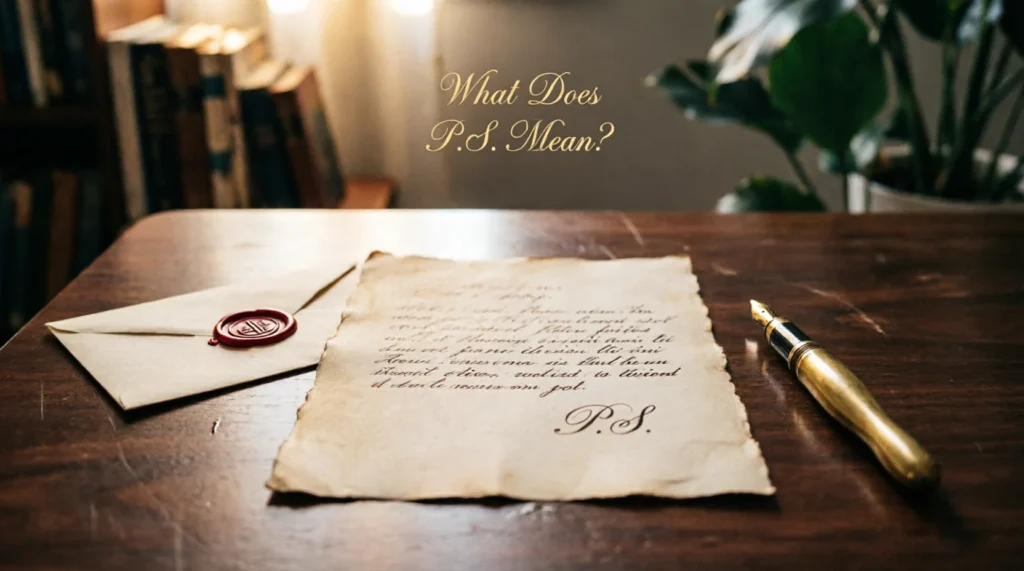
PS stands for a short note added after the main content of a letter has already ended. It appears below the signature and is typically used to include an additional thought, reminder, or piece of information.
Traditionally, writers used PS when they remembered something after finishing their letter. Instead of rewriting the entire message, they simply added a note at the bottom.
For example:
Dear Sarah,
I hope your trip goes well. Let me know when you arrive safely.
Best wishes,
John
PS: Don’t forget to bring your camera!
In this example, the main message ends before the PS. The writer then adds an extra reminder.
Today, PS is used not only for forgotten thoughts but also for highlighting important information. Marketers, businesses, and content creators often use it to attract attention because readers naturally notice text that appears after the main message.
Quick Examples
- PS: Thanks for helping me yesterday.
- PS: The meeting starts at 10 a.m.
- PS: Check your email for the attachment.
- PS: Happy Birthday! 🎉
Full Form, Stands For & Short Meaning of PS
The abbreviation PS stands for Post Scriptum, a Latin phrase meaning “written after.”
The English equivalent is “postscript.”
Breakdown
- P = Post
- S = Scriptum
- Meaning = Written after the main text
A postscript is any note added after the conclusion of a letter.
Common Definitions
| Term | Meaning |
|---|---|
| PS | Post Scriptum |
| Postscript | Additional note after the letter |
| Written After | Information added after completion |
People often use PS to:
- Add forgotten information
- Highlight important details
- Make communication more personal
- Create emphasis in marketing messages
Although the original purpose was practical, modern writers often use PS intentionally even when they haven’t forgotten anything.
Origin, History & First Known Use of PS
The history of PS dates back centuries, long before computers, smartphones, or email existed.
When people wrote letters by hand, making corrections was difficult. If a writer remembered an important detail after signing a letter, rewriting several pages would take time and effort.
Instead, they added a Post Scriptum at the bottom.
The practice became common throughout Europe during the Renaissance and continued for hundreds of years.
Historical Timeline
Ancient Latin Usage
- The phrase “Post Scriptum” originated from Latin writing traditions.
Handwritten Letter Era
- Writers used PS to include forgotten information.
19th Century
- Personal letters commonly included postscripts.
20th Century
- Businesses adopted PS for emphasis.
Digital Era
- PS became common in emails, newsletters, and marketing.
Interestingly, studies in direct-response marketing found that many readers look at the PS section before reading the entire message. Because of this, marketers began using PS strategically.
How People Use PS in Daily Conversations
Although PS originated in letters, people now use it in many forms of communication.
In daily life, PS often serves as a casual afterthought.
Common Uses
1. Adding Extra Information
Example:
“See you tomorrow.
PS: Bring your notebook.”
2. Sharing a Reminder
Example:
“PS: Your appointment is at 3 PM.”
3. Showing Affection
Example:
“PS: I miss you ❤️”
4. Making a Joke
Example:
“PS: I still owe you pizza 🍕”
5. Highlighting Importance
Example:
“PS: This deadline cannot be extended.”
People use PS because it feels conversational and personal. It can make messages feel warmer and more authentic.
PS Meaning Across WhatsApp, Instagram, TikTok & Snapchat
The meaning of PS remains largely the same across social platforms.
Users often add PS at the end of long messages.
Example:
“Good luck with your interview tomorrow.
PS: You’ve got this! 💪”
PS may appear in captions.
Example:
“Vacation photos are finally here.
PS: More pictures coming soon!”
TikTok
Creators use PS to add side comments.
Example:
“PS: Watch until the end 😂”
Snapchat
Friends use PS for personal reminders.
Example:
“PS: Don’t forget our streak 🔥”
Social Media Usage
PS often means:
- Extra note
- Reminder
- Bonus information
- Friendly comment
- Hidden message
Unlike many internet abbreviations, PS has kept its original meaning across platforms.
Different Meanings of PS in Other Fields
Although PS usually means Post Scriptum, it can have other meanings depending on context.
Education
PS = Public School
Gaming
PS = PlayStation
Science
PS = Picosecond
Business
PS = Professional Services
Medicine
PS = Performance Status
Postal Services
PS = Postal Service
Context Matters
For example:
- “I bought a new PS.” → PlayStation
- “PS: Don’t forget your keys.” → Post Scriptum
The surrounding text usually reveals the intended meaning.
Common Confusions, Mistakes & Wrong Interpretations
Many people misunderstand PS because it appears in different situations.
Common Mistakes
Thinking PS Means “Personal Statement”
In letters, PS almost never means personal statement.
Using PS Before the Signature
A postscript should appear after the signature.
Incorrect:
PS: Thanks.
John
Correct:
John
PS: Thanks.
Overusing Multiple Postscripts
Too many postscripts can look messy.
Example:
PS: Thanks.
PPS: See you soon.
PPPS: Call me.
Assuming It’s Only for Forgotten Thoughts
Modern writers often use PS intentionally rather than as an afterthought.
Similar Terms, Alternatives & Related Writing Expressions
Several alternatives can serve the same purpose as PS.
Related Terms
- Postscript
- Additional Note
- Side Note
- By the Way
- One More Thing
- Extra Reminder
Similar Abbreviations
- PPS = Post-Postscript
- PPPS = Post-Post-Postscript
- FYI = For Your Information
- BTW = By The Way
- NB = Nota Bene (Take Note)
Each serves a slightly different purpose, but all help add information outside the main message.
Examples of PS in Real Chat Situations
Here are realistic examples showing how PS appears in everyday communication.
Friend Message
“Have fun at the concert!
PS: Send photos 📸”
Family Message
“Drive safely.
PS: Call when you arrive.”
Business Email
“Thank you for your order.
PS: Your discount code expires tomorrow.”
Teacher Message
“Great work on your project.
PS: Keep up the effort.”
Social Media Caption
“New vlog is live!
PS: The bloopers are hilarious 😂”
These examples show how flexible PS can be.
How to Reply When Someone Uses PS
There is no special rule for replying to a PS.
Simply respond to the information included.
Examples
Message:
“PS: Don’t forget your umbrella.”
Reply:
“Thanks for the reminder!”
Message:
“PS: I miss you.”
Reply:
“I miss you too ❤️”
Message:
“PS: The event starts at 6 PM.”
Reply:
“Got it, see you there!”
The response depends entirely on the content of the postscript.
Is PS Still Popular? Trends & Online Usage
Yes, PS remains surprisingly popular.
Even though editing digital messages is easy, people continue using PS because it attracts attention and feels personal.
Why It Survives
- Easy to recognize
- Adds emphasis
- Creates a friendly tone
- Works across generations
- Effective in marketing
Many email marketers place special offers in the PS section because readers frequently notice it.
Modern Trends
Today, PS appears in:
- Emails
- Newsletters
- Business messages
- Social media captions
- Blog content
- Promotional campaigns
Its role has evolved from a practical writing tool into a powerful communication technique.
Internal Linking Suggestions
To improve SEO and user navigation, consider linking to related topics such as:
- What Does FYI Mean?
- What Does BTW Mean?
- What Does IMO Mean?
- What Does TLDR Mean?
- What Does BRB Mean?
- Common Texting Abbreviations Guide
- Social Media Slang Dictionary
Definition of PS in Letter Writing
PS stands for Post Scriptum, a Latin phrase meaning “written after”. In simple terms, it is a short note added after a letter has been finished and signed. It is used when the writer wants to include something extra without rewriting the entire message.
Key idea:
- PS = Additional message added after completion of writing
It usually appears at the very bottom of a letter.
Why PS is Used in Letters
PS is used for several practical and emotional reasons in communication:
- To add a forgotten detail
- To emphasize an important point
- To include a personal note
- To make the message feel more natural
- To create a friendly tone in formal writing
Even though writing tools today allow editing, PS is still used because it feels personal and attention-grabbing.
Structure and Placement of PS in a Letter
In traditional letter formatting, PS always comes after the main content and signature.
Correct format:
- Main message
- Closing line (e.g., Regards, Sincerely)
- Signature
- PS section
Example structure:
- Letter body ends
- Name/signature
- PS: Final extra note
This placement makes PS stand out clearly from the main message.
Emotional Impact of Using PS
PS is not just functional—it also has emotional value.
It can:
- Make messages feel more personal
- Add warmth or affection
- Create curiosity in the reader
- Highlight something important subtly
For example:
PS: I’m really proud of you ❤️
This small addition often leaves a stronger emotional impression than the main message itself.
PS in Formal vs Informal Letters
PS is used differently depending on tone:
Formal Letters
- Used sparingly
- Adds important reminders or corrections
- Keeps tone professional
Example:
- PS: Please submit the report by Monday.
Informal Letters
- Used freely
- Adds emotions, jokes, or personal notes
Example:
- PS: Don’t forget our movie night 🍿
Psychological Reason Behind PS Usage
Interestingly, PS works because of how people read messages.
Readers often:
- Scan the end of messages first
- Remember final points more strongly
- Pay attention to unexpected additions
That’s why PS is often used in:
- Emails
- Advertisements
- Sales messages
It naturally draws attention without forcing it.
PS in Modern Digital Communication
Even in WhatsApp, Instagram, and emails, PS is still widely used.
It appears in:
- Chat messages
- Social media captions
- Email newsletters
- Online marketing content
Example:
- “See you tomorrow!
PS: Bring snacks 😄”
It helps messages feel more conversational and human.
Common Situations Where PS is Added
People usually add PS in situations like:
- After forgetting something
- When adding a final reminder
- When expressing feelings after closing message
- When highlighting urgency
- When adding humor or surprise
Example:
- PS: Your password will expire soon
- PS: I miss you a lot
- PS: Don’t be late!
Difference Between PS, PPS, and PPS
Sometimes people confuse multiple postscript forms:
- PS = First extra note
- PPS = Post-postscript (second extra note)
- PPPS = Third additional note (rare)
However, using too many postscripts can make a message look messy.
PS vs Main Message Importance
Although PS is added at the end, it is often very important.
In many cases:
- PS contains the key reminder
- PS includes the emotional message
- PS highlights urgency or action
That’s why marketers often place offers in PS sections.
Common Mistakes When Using PS
People often misuse PS in letters:
- Using it before closing signature ❌
- Writing multiple unrelated PS notes ❌
- Overloading PS with long paragraphs ❌
- Using PS instead of main content ❌
Correct usage is always short and clear.
Real-Life Examples of PS in Letters
- PS: Don’t forget to reply by Friday.
- PS: I’ll call you later tonight.
- PS: Congratulations on your achievement!
- PS: The meeting time has changed to 4 PM.
- PS: Missing you already ❤️
These examples show how flexible PS can be in communication.
FAQs
What does PS mean in a letter?
PS means Post Scriptum, which translates to “written after.” It is a note added after the main letter.
Why do people use PS?
People use PS to add extra information, reminders, personal notes, or important details after the main message.
Is PS still used in emails?
Yes. Many personal and professional emails include a PS section.
What comes after PS?
If another note is added, writers may use PPS, which stands for Post-Postscript.
Can PS be used in text messages?
Yes. People often use PS in texts, WhatsApp messages, and social media captions.
Does PS always mean Post Scriptum?
No. In some contexts, PS can mean PlayStation, Public School, Professional Services, or other terms.
Where should PS be placed?
PS should appear after the signature or closing section of a letter.
Conclusion
If you’ve ever wondered what does PS mean on a letter the answer is simple: it stands for Post Scriptum, meaning written after. Traditionally it allowed writers to add information after finishing a handwritten letter.
Today PS remains popular because it helps emphasize important points, create a personal touch, and capture readers’ attention.
Whether you’re writing a letter, email, social media caption, or business message, PS remains a useful communication tool. Its centuries-old history proves that even the smallest writing conventions can have lasting value.
The next time you see a PS at the bottom of a message, you’ll know exactly what it means and why it’s there.

Hi, I’m Julia Mark, the creator and writer behind Punshifter.
Punshifter started as a fun idea to turn everyday words into clever humor. I’ve always enjoyed playing with language, and puns felt like the perfect way to mix creativity with laughter. Through Punshifter, I share original puns, witty jokes, and playful word combinations designed to make people smile.
I focus on creating original, easy-to-read, and lighthearted content that anyone can enjoy. Every piece on Punshifter is written with care, creativity, and a love for clever wordplay.
Thanks for being part of the Punshifter community and enjoying the humor with me.
— Julia Mark