Have you ever dropped your phone sent a message to the wrong person or made a small mistake and instantly said Oops ? If so you’re not alone. The word oops is one of the most common expressions in English.
People use it every day to acknowledge a mistake accident or unexpected situation in a lighthearted way.
Many people search for oops meaning because they see it in text messages, social media comments memes or everyday conversations.
While the word seems simple, it has several uses depending on the context. It can express embarrassment surprise humor or even sarcasm.
In this guide you’ll learn the full meaning of oops its origin social media usage examples related slang and how people use it online and offline.
By the end, you’ll understand exactly what oops means and when to use it naturally.
What Does Oops Mean?
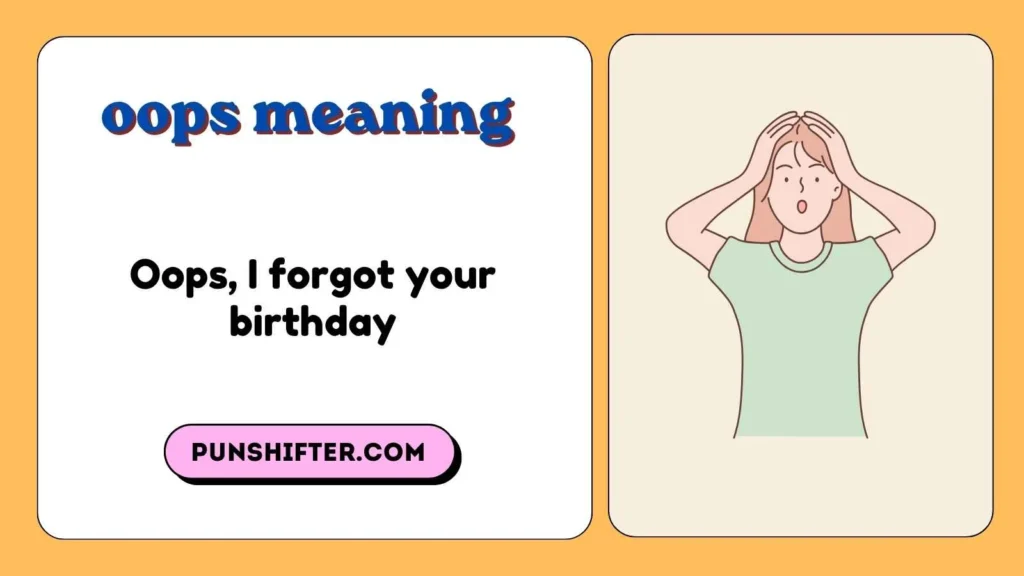
The word oops is an informal exclamation used when someone makes a mistake, has an accident or notices something unexpected.
In simple terms, oops means “I made a mistake” or “something went wrong.”
People often say it immediately after an error occurs. It helps make the situation feel less serious and often adds a touch of humor.
Quick Examples
- “Oops, I dropped my coffee.”
- “Oops, I sent the text to the wrong person.”
- “Oops, I forgot your birthday.”
The word is friendly and casual. It is commonly used by children, teenagers, and adults alike.
Key Meanings of Oops
- Small mistake
- Accident
- Unexpected situation
- Minor embarrassment
- Playful acknowledgment of an error
Unlike stronger expressions, oops usually refers to minor issues rather than major problems.
Full Form Stands For & Short Meaning of Oops
One common question is whether oops is an abbreviation or acronym.
The answer is simple:
Oops does not have an official full form.
It is an independent English interjection rather than an acronym like LOL, BRB, or OMG.
Short Meaning
The short meaning of oops is:
“I made a mistake.”
Some people create funny unofficial backronyms such as:
- OOPS = Out Of Place Situation
- OOPS = Oh, Our Problem Started
However, these are not official meanings.
What Oops Stands For
Technically, it does not stand for anything. It is simply a word used to react to an error or accident.
Because of its simplicity, it has remained popular across generations and platforms.
Origin, History & First Known Use of Oops
The history of oops is quite interesting.
Linguists believe that oops developed as a variation of older exclamations such as:
- Oops-a-daisy
- Whoops
- Woops
The term became increasingly popular in spoken English during the 20th century.
Early Usage
Originally, expressions like “whoops” were used when someone stumbled, dropped something, or made a mistake.
Over time, speakers shortened the expression into the simpler and faster version:
Whoops → Oops
Why It Became Popular
Several factors helped spread the word:
- Easy to pronounce
- Suitable for all ages
- Non-offensive
- Useful in everyday situations
Today, oops is recognized worldwide and appears in conversations, books, movies, TV shows, memes, and social media posts.
How People Use Oops in Daily Conversations
People use oops in many everyday situations.
It usually appears right after a mistake or accident.
Common Situations
Forgetting Something
“Oops, I forgot my keys.”
Sending a Wrong Message
“Oops, wrong chat.”
Making a Typo
“Oops, I meant Friday, not Thursday.”
Dropping Something
“Oops, my glass slipped.”
Emotional Tone
Depending on context, oops can sound:
- Funny
- Embarrassed
- Playful
- Apologetic
- Casual
Daily Conversation Examples
- Friend: “Did you lock the door?”
- You: “Oops, I forgot.”
- Mom: “You ate the last cookie?”
- Child: “Oops! 😅”
- Coworker: “That’s the wrong file.”
- You: “Oops, I’ll fix it.”
Because it sounds gentle, oops often reduces tension in conversations.
Oops Meaning Across WhatsApp, Instagram, TikTok & Snapchat
Social media has given oops even more uses.
On WhatsApp, oops usually means:
- Wrong message
- Mistake in texting
- Typing error
Example:
- “Oops, sent that to the wrong group.”
On Instagram, users write oops when:
- Posting something embarrassing
- Sharing a funny mistake
- Commenting on unexpected situations
Example:
- “Oops, didn’t realize my shirt was inside out 😂”
TikTok
TikTok creators often use oops in:
- Funny videos
- Fail compilations
- Unexpected moments
Example:
- “Oops, that wasn’t supposed to happen.”
Snapchat
On Snapchat, oops commonly appears after:
- Sending a snap to the wrong person
- Accidentally posting a story
- Sharing something unintentionally
Example:
- “Oops, wrong snap 😭”
Across all platforms, the meaning remains connected to mistakes and unexpected events.
Different Meanings of Oops in Other Fields
Although oops mainly refers to mistakes, it can have specialized meanings in some areas.
Computing and Technology
In programming discussions, developers sometimes say:
“Oops, the code crashed.”
Here it still indicates an error.
Gaming
Gamers use oops when they make mistakes.
Example:
- Missing a shot
- Pressing the wrong button
- Accidentally helping the opponent
Business
In workplace conversations, employees may say:
“Oops, I attached the wrong document.”
Marketing
Brands occasionally use oops in campaigns to create a playful image.
For example:
- “Oops, our sale started early.”
Even in specialized industries, the core meaning remains tied to errors or accidents.
Common Confusions, Mistakes & Wrong Interpretations
Many people misunderstand oops.
Oops Is Not an Acronym
A common misconception is that each letter stands for words.
In reality, oops is simply a standalone word.
Oops vs Sorry
These words are related but different.
Oops
Acknowledges a mistake.
Sorry
Expresses regret.
Example:
- “Oops, I spilled your drink.”
- “Sorry, I’ll clean it up.”
Oops vs Whoops
Both mean nearly the same thing.
However:
- Whoops sounds slightly older.
- Oops is more common online.
Oops Is Usually Informal
Avoid using it in very formal writing or serious professional reports.
Similar Terms, Alternatives & Related Slang
Several expressions have meanings similar to oops.
Popular Alternatives
- Whoops
- Uh-oh
- My bad
- Sorry
- Yikes
- Awkward
- Oh no
Slang Variations
Younger users sometimes replace oops with:
- My bad
- Bruh
- Well, that happened
- RIP
Comparison
| Expression | Meaning |
|---|---|
| Oops | Minor mistake |
| Uh-oh | Problem ahead |
| My bad | Admitting fault |
| Yikes | Embarrassment |
| Oh no | Negative surprise |
Each phrase has its own tone, but all can appear in similar situations.
Examples of Oops in Real Chat Situations
Here are realistic examples.
Friends Chat
Friend: “Did you bring the tickets?”
You: “Oops, they’re still at home 😅”
Family Chat
Mom: “Why is the milk on the counter?”
You: “Oops, forgot to put it back.”
School Chat
Student: “Homework due today?”
Friend: “Oops, I thought it was tomorrow.”
Work Chat
Boss: “You sent the draft?”
Employee: “Oops, sending now.”
Social Media Comments
- “Oops, didn’t notice that!”
- “Oops 😂”
- “Well… oops.”
These examples show how naturally the word fits into everyday communication.
How to Reply When Someone Says Oops
Your response depends on the situation.
Casual Responses
- “No worries.”
- “It’s okay.”
- “Happens to everyone.”
- “Don’t worry about it.”
Funny Responses
- “Classic 😂”
- “Oops indeed!”
- “Nice save!”
- “Caught in 4K 😆”
Professional Responses
- “Please correct it when possible.”
- “Thanks for letting me know.”
- “Let’s fix the issue.”
Example Replies
Person: “Oops, wrong file.”
Reply: “No problem, send the correct one.”
Person: “Oops 😅”
Reply: “Haha, happens!”
Is Oops Still Popular? Trends & Online Usage
Yes, oops is still extremely popular.
Its popularity continues because:
- Easy to understand
- Works in every age group
- Fits online communication
- Suitable for memes
- Universal meaning
Why It Survives Trends
Many internet slang terms disappear quickly.
However, oops remains relevant because it describes a common human experience: making mistakes.
Where It’s Most Common
- TikTok
- Snapchat
- YouTube comments
- Online gaming chats
Even as new slang emerges, oops continues to be widely recognized around the world.
Internal Linking Suggestions
To improve SEO and user engagement, consider linking to related articles such as:
- LOL Meaning
- BRB Meaning
- OMG Meaning
- TBH Meaning
- SMH Meaning
- WYF Meaning
- WDYM Meaning
- FR Meaning
- NGL Meaning
- TTYL Meaning
Psychological Meaning of Saying “Oops”
The word oops is more than just a reaction to a mistake. Psychologically, it often acts as a social tool that softens embarrassment and reduces tension. When people say “oops,” they are usually acknowledging an error while signaling that the mistake was accidental rather than intentional.
Researchers who study communication often note that short expressions like oops help maintain positive social interactions. Instead of creating conflict, the word makes situations feel lighter and easier to move past.
Why People Instinctively Say Oops
- To admit a small mistake quickly
- To avoid awkward silence
- To show honesty
- To reduce embarrassment
- To make others feel comfortable
Examples
- “Oops, I forgot your coffee.”
- “Oops, wrong email.”
- “Oops, I clicked the wrong button.”
In many situations, saying oops immediately shows awareness of the mistake, which often prevents misunderstandings.
Oops in Pop Culture and Entertainment
The word oops became even more famous through movies, television shows, music, and internet culture. Because it is simple and recognizable, writers and entertainers frequently use it to create humor or highlight unexpected situations.
Many comedy scenes rely on a character making a mistake and responding with a casual “oops.” The contrast between a big problem and a small reaction often makes audiences laugh.
Why Entertainment Uses Oops
- Easy for audiences to understand
- Creates comedic timing
- Works across age groups
- Sounds playful rather than serious
Common Pop Culture Uses
- Comedy sketches
- Cartoon dialogue
- Movie scenes
- Viral internet memes
- Funny reaction GIFs
Its widespread use in entertainment has helped keep the term relevant for decades.
When Not to Use Oops
Although oops is useful, it is not appropriate in every situation. Since the word sounds casual and lighthearted, using it during serious events can appear insensitive or unprofessional.
Situations Where Oops May Not Be Suitable
- Major workplace errors
- Serious accidents
- Legal matters
- Medical emergencies
- Formal business communication
Better Alternatives
Instead of saying oops, you might use:
- “I apologize.”
- “I’m sorry.”
- “I take responsibility.”
- “Thank you for your patience.”
Example
Less suitable:
- “Oops, we lost important company data.”
More professional:
- “We apologize for the error and are actively resolving it.”
Understanding context helps ensure the word is used appropriately.
Oops as a Sign of Honesty
One reason people appreciate the word oops is that it often signals honesty. Rather than hiding a mistake, the speaker openly admits it.
In personal relationships, this can build trust because people generally value transparency over excuses.
How Oops Creates Trust
- Shows accountability
- Acknowledges errors immediately
- Reduces defensiveness
- Encourages open communication
Examples
- “Oops, I forgot to call you.”
- “Oops, I mixed up the dates.”
- “Oops, that’s my mistake.”
When used sincerely, the word demonstrates that someone recognizes what happened and is not trying to avoid responsibility.
Oops in Customer Service and Marketing
Businesses sometimes use the word oops in marketing campaigns to sound more human and approachable. Brands understand that customers often respond positively to honest communication.
Common Marketing Uses
- Accidental discount announcements
- Product launch delays
- Website maintenance notices
- Promotional campaigns
Examples
- “Oops! Our sale started earlier than planned.”
- “Oops! We added an extra discount.”
- “Oops! The inventory sold out faster than expected.”
Using friendly language can make a company feel less corporate and more relatable, especially on social media.
The Difference Between Oops, Uh-Oh, and Oh No
These expressions are often confused because they all react to unexpected situations. However, they carry different emotional meanings.
Oops
Usually follows a minor mistake.
Example:
- “Oops, I spilled some water.”
Uh-Oh
Suggests a problem may be coming.
Example:
- “Uh-oh, the battery is at 1%.”
Oh No
Expresses concern or disappointment.
Example:
- “Oh no, I missed the train.”
Quick Comparison
| Phrase | Typical Emotion |
|---|---|
| Oops | Minor mistake |
| Uh-oh | Warning sign |
| Oh no | Concern or disappointment |
Choosing the right phrase helps communicate the correct emotion.
Why Oops Works So Well Online
The internet moves quickly, and users often prefer short, expressive words. Oops fits perfectly into this environment because it communicates a complete reaction using only four letters.
Benefits of Using Oops Online
- Fast to type
- Easy to understand
- Works globally
- Adds personality
- Fits memes and comments
Typical Online Examples
- “Oops, wrong screenshot.”
- “Oops 😂”
- “Oops, didn’t mean to post that.”
Its simplicity is one of the main reasons it continues to thrive across digital platforms.
Funny and Sarcastic Uses of Oops
Not every use of oops is sincere. Sometimes people use it sarcastically to joke about obvious mistakes or intentional actions.
Sarcastic Examples
- “Oops, I accidentally ate the whole pizza.”
- “Oops, stayed up until 3 AM again.”
- “Oops, bought another pair of shoes.”
In these situations, the speaker usually knows exactly what they did and is using humor to acknowledge it.
Why Sarcasm Works
- Creates humor
- Shows self-awareness
- Makes stories more entertaining
- Encourages engagement on social media
This playful use has become especially common in memes and viral content.
Oops and Modern Internet Memes
Memes often use oops to make mistakes look funny rather than embarrassing. The word is frequently paired with screenshots, reaction images, and fail videos.
Popular Meme Formats
- Unexpected outcomes
- Typing mistakes
- Awkward situations
- Failed challenges
- Wrong assumptions
Example Captions
- “Oops, that wasn’t supposed to happen.”
- “Oops, my secret account liked the post.”
- “Oops, forgot everyone could see that.”
Because memes depend on relatable experiences, oops remains one of the internet’s favorite reaction words.
How Children Learn the Word Oops
Many children learn oops at a very young age because parents often use it during everyday activities.
Common Childhood Situations
- Dropping toys
- Spilling drinks
- Making drawing mistakes
- Knocking things over
Parents often prefer the word because it sounds gentle and encourages learning rather than punishment.
Example
Parent:
- “Oops, the blocks fell down. Let’s build them again.”
This positive approach helps children understand mistakes as a normal part of learning and growth.
FAQs
What is the meaning of oops in texting?
In texting, oops usually means “I made a mistake” or “something happened accidentally.”
Is oops a real English word?
Yes. Oops is a recognized English interjection used to acknowledge mistakes or accidents.
Does oops have a full form?
No. Oops is not an acronym and has no official full form.
What is the difference between oops and sorry?
Oops acknowledges a mistake, while sorry expresses regret for that mistake.
Is oops rude?
No. Oops is generally considered friendly, casual, and non-offensive.
Why do people say oops online?
People use oops online to react to mistakes, unexpected situations, embarrassing moments, or humorous accidents.
Is oops still popular in 2026?
Yes. Oops remains widely used across social media, messaging apps, and everyday conversations.
Conclusion
The word oops may be small but it plays a big role in everyday communication. It is a simple friendly way to acknowledge mistakes accidents and unexpected situations without making them seem too serious.
Whether you’re texting a friend posting on social media chatting at work or reacting to a funny moment, oops helps communicate a sense of honesty and humor.
Unlike many internet slang terms that come and go oops has remained popular for decades because it is easy to understand and useful in countless situations. From WhatsApp and Instagram to real-life conversations its meaning stays consistent: something went wrong, but it’s usually not a big deal.
The next time you hear or use oops, you’ll know exactly what it means and why it’s still one of the most recognizable expressions in English.

Hi, I’m Julia Mark, the creator and writer behind Punshifter.
Punshifter started as a fun idea to turn everyday words into clever humor. I’ve always enjoyed playing with language, and puns felt like the perfect way to mix creativity with laughter. Through Punshifter, I share original puns, witty jokes, and playful word combinations designed to make people smile.
I focus on creating original, easy-to-read, and lighthearted content that anyone can enjoy. Every piece on Punshifter is written with care, creativity, and a love for clever wordplay.
Thanks for being part of the Punshifter community and enjoying the humor with me.
— Julia Mark